Earlier sunsets hit the evening commute as pedestrian crashes rise
Clocks fall back Sunday, putting sunset between about 4:30 and 6 p.m. Here's what that means for the walk home.

Pedestrian crashes rise during commute after daylight saving time
Daylight saving time ends Sunday and darker evenings are here as we turn the clocks back.
Sunset now falls around 5 p.m. or earlier across much of the country, right in your evening commute and your walk home.
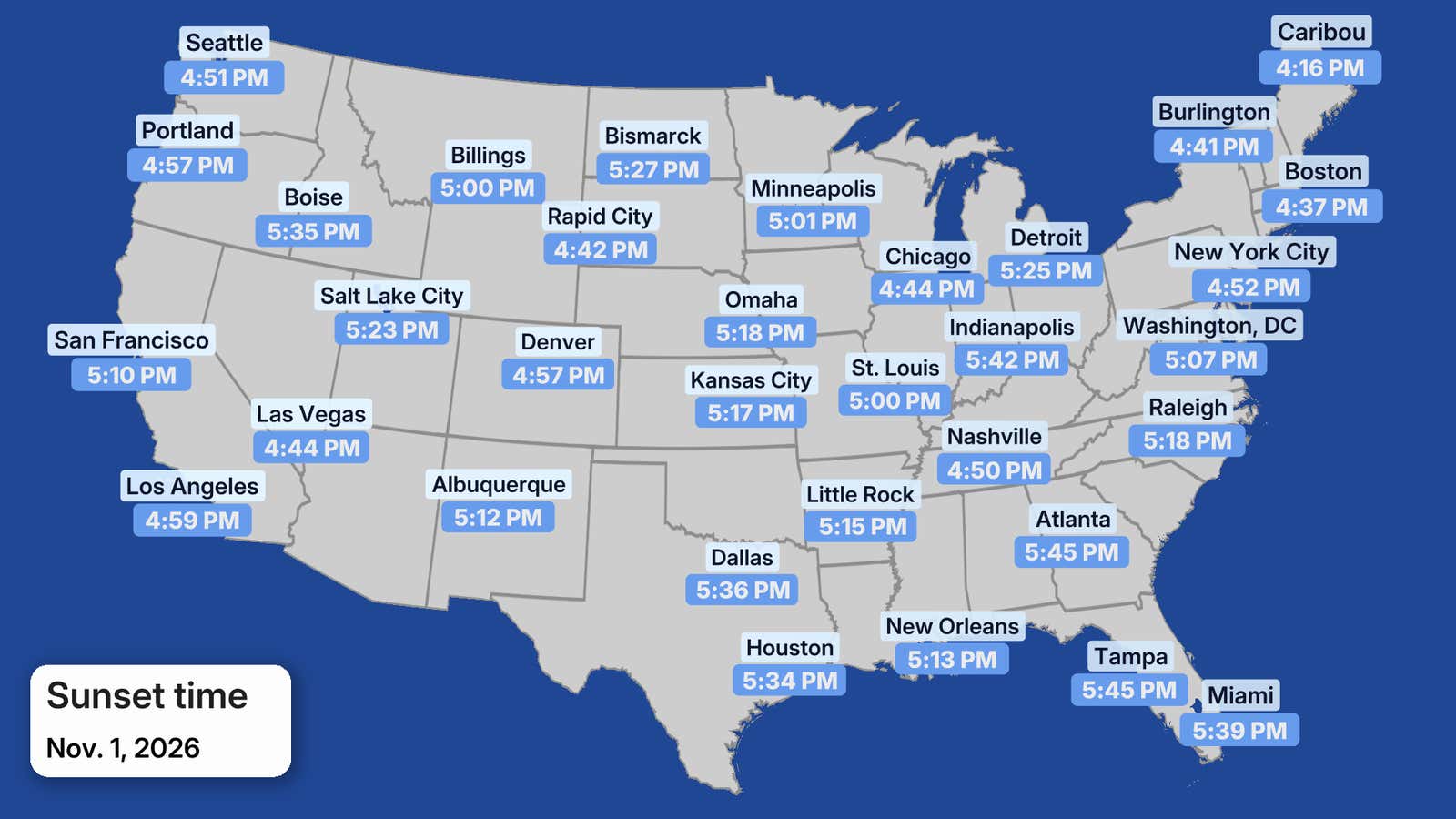
How sunset times change across the U.S.
Sunset times vary by region.

Southeast: The latest sunsets, close to 6 p.m. (5:45 p.m. in Atlanta on Nov. 1).
Midwest and West: Around 5 p.m. (Chicago 4:44 p.m., Denver 4:57 p.m.).
Northeast: Before 5 p.m. (Boston 4:37 p.m., New York City 4:52 p.m.). This is also where pedestrian crashes climb at the evening commute.
Get More of Our News on Google
Set The Weather Company as a 'Preferred Source' to get quicker access to the news you value.

Alaska: Before 4 p.m. by Nov. 5, with the sun setting at 3:58 p.m. in Juneau.
Arizona and Hawaii don't change their clocks
(MORE: Fall back hits these places hardest, with sunsets before 4:30 p.m.)
Pedestrian crashes rise in the 5 p.m. hour
Pedestrians face the biggest jump in crashes once the clocks fall back.
AAA Northeast analyzed crash data in four Northeast states and found that pedestrian crashes in the 5 p.m. hour rose from October to November in each one, by more than crashes overall. The group says 5 to 6 p.m. becomes an increasingly dangerous time on the road.
In Connecticut, pedestrian crashes in that hour rose 147%, from 43 in October to 106 in November, based on 2020 to 2024 data.
In New York, they nearly doubled, up 98% in 2023. Massachusetts saw the number double in 2024.
Nationally, more than three-quarters of pedestrian deaths with known lighting conditions happen after dark.
The Governors Highway Safety Association puts the exact figure at 76.5% in 2024, regardless of whether there was artificial lighting. Another 19.9% happened in daylight and 3.6% at dawn or dusk.
How to stay safe on the new commute
If you're walking, make sure to wear bright or reflective gear.
If you're driving, AAA offers these tips as it gets darker earlier:
- Check your headlights. Headlights can show signs of deterioration after just three years, such as yellowing or clouding. Replacement and restoration services are available at most repair shops. Keep your windshield clean, too, and make sure your wiper blades aren't leaving streaks.
- Lower your speed. Slow down to make up for reduced visibility, and increase your following distance to four or more seconds behind the car in front of you.
- Turn slowly. Slow to 5 mph when you turn at intersections, especially where street lighting is poor or pedestrians are likely to be present. Don't try to speed through a yellow light and turn at the same time.
- Beware of glare. The time change means sun glare can affect commuters at earlier hours. Use your sun visor, invest in polarized sunglasses and leave extra room between you and the car in front of you when the sun is in your eyes.
- Keep your eyes moving. Don't focus only on the middle of the area your headlights light up. Watch for flashes of light that could signal another vehicle at the top of hills, around curves and at intersections.
Treat the first few weeks as a new commute.
(MORE: Your daylight savings time questions answered)
Faiza Mohammed is a meteorologist intern at weather.com. She studied geography and worked with the Weather Dawgs team at the University of Georgia. She also received her master's in Earth and Atmospheric Sciences from the Georgia Institute of Technology.
Loading comments...